


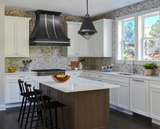

How to choose ventilation for your custom range hood:
1. Three Different Ventilation Systems:
Internal: Mostly used and easier to install. Internal Motor is contained in the liner, which is installed inside the hood. Vent to the outdoors through duct either from back or top of the range hood.
Remote: Remote blower is located outside the hood & liner, usually in an attic, basement, or exterior of the home etc. Quieter than an internal motor while requires more complex installation. Remote ventilation often requires more space and planning.
Ductless: As its name, ductless ventilation does not require ductwork at all. Using a filter instead to capture grease, smoke and odors, then recirculates fresh air back into the kitchen. The filters need to be cleaned or replaced regularly to maintain the effectiveness.
 |
 |
 |
| Internal: Motor contained in the liner. Vent to the outdoors through duct. | Remote: Blower is located outside separately, in attic, basement etc. | Ductless: Using a filter to recirculate air in your kitchen without ductwork. |
2. About CFM (aka. Cubic Feet per Minute):
CFM (Cubic Feet per Minute) measures the airflow capacity of a ventilation system. A higher CFM indicates greater airflow and stronger suction power. A 600 CFM is generally sufficient for most regular kitchen cooking needs.
Keep in mind that CFM requiremens may vary by states due to specific building codes. To ensure compliance and function, we recommend consulting your HVAC or contractor to determine the appropriate CFM level for your ventilation system.
3. How to install Elite insert to the range hood cover?Before install a insert, please power on to make sure the vent and light can function properly.
Connect the duct first, then wires to the vents, gently lift the insert inside the hood and assemble the insert to the range hood from both sides by screws.
For detailed information of the insert user manual, please contact us at info@eliterangehood.com.